
(1874–1952), Jewish scholar and statesman; President of the Zionist World Organization and the Jewish Agency, first President of Israel (1949). Archive of eight items consisting of seven letters in English and Hebrew (including one ALS), and one typed proclamation, five signed and one hand-notated, dating from 1914 to 1951, totaling 18 pages on 19 sheets.
$ 26,698 / 25.000 €
(47361)
Jewish chemist and statesman (1874–1952) who helped secure the Balfour Declaration of 1917, served as President of the World Zionist Organization, and became the first President of Israel. Archive of eight items consisting of seven letters in English and Hebrew (including one ALS) and one typed proclamation, ranging in date from 1914 to 1951 and totaling 20 pages on 19 sheets. Five are signed and one is hand-notated. The letters are written to notable figures Field Marshall Jan Christian Smuts, Moshe Sharett, Walter Ettinghausen, and Israel Zangwill, and are incredibly rich in content, including thoughts of Europe after World War I, the settlement of Jews in Palestine, and secret questions about the congress of Zionists and about the “advancement of our aims in Palestine.” Two letters to Zangwill are unsigned: one is a retained carbon copy and one is a two-page TLS bearing a stamped signature.
The six-page letter to Smuts is also unsigned, but is heavily notated in Weizmann's hand. A selection of the letters follows: Two TLSs to Zangwill with outstanding Zionist content, signed "Ch. Weizmann," each two pages, dated 1914. First, in part: "So far nothing has happened in Russia to ameliorate in the least degree the situation of the Jews, but on the contrary, the laws against us are handled with the greatest possible severity and no relaxation whatsoever…The moral and material distress is beyond description…I am inclined to think with you that at the present historical moment, through which the civilized world is passing, we may hope that the powers, which are going to alter the map of Europe, will find time to consider the fate of 13 millions of Jews, who, no doubt represent a small nation, which has given to the world as much as any other nation." Second, in part: "The Palestinian problem…is worthy of consideration, and I would like to emphasize the point, that a settlement of a comparatively small number of Jews—I spoke then of a million—which may be established in Palestine in the course of the next 30 or 40 years." Short ALS, written and signed in Hebrew, one page, January 30, 1918, to Sharett, in part: “The times are rough my friend, Moshe, but good times are few and valuable. It seems as if blowing a great horn loud and clear is needed, and only then, maybe, the walls of Jericho will collapse.” TLS signed by Weizmann and Selig Brodetsky, one page both sides, October 23, 1941, in part: "Our efforts and achievements in Palestine…provide the only lasting solution of the Jewish problem…bring before the British public opinion, as well as before the Jews of this country, the urgency of the Jewish problem and the important part which Palestine can play in its solution through large-scale immigration and colonisation under suitable political conditions." Heavily-notated typed letter to Smuts, six pages, February 2, 1943, in part: “There is another aspect to the problem which is worth noting: Unconsciously, perhaps, the American public, and even certain quarters in Washington, have been affected by the anti-Semitic virus. The deadly poison of Hitlerism has spread far and wide. The propaganda that this is a ‘Jewish War’ is met not by counter-propaganda, but by a conspiracy of silence regarding the Jewish problem. Whereas the Nazi leaders remember us in every one of their blatant utterances, conversely, the leaders of the democracies, with rare exceptions, try to forget our existence. Often I am overcome by the terrible feeling that so far as the Jews are concerned, the Hitlerites have won the war.” Typed proclamation, signed in Hebrew as president, dated August 20, 1951, issued for “a special session of the 23rd Zionist Congress for the Jews National Fund (the KKL) Jubilee," reads, in part (translated): “The KKL is a unique institution in our revival movement of the people and country. A tool of redemption for both the land and the man, an impetus to return land for a nation which is in lack of land and to return to the land the man who works it and revives it with labour, an institution that returned to our young, the Pioneers of Zion and sons, the feeling of whole Hebrew people, with upright bearing and self confident, for their legs are standing on their land. And here the KKL’s special value as an institution which performed greatly, peacefully and with the strength of a great idea, to the fulfillment of the Israeli land reform.” Retained carbon copy is of a neatly-penned two-page ALS, in English, dated October 19, 1914, to Zangwill, in part: “My plans are based naturally on one cardinal assumption…that the allies will win…I am afraid I don’t share your optimism that a change for the better in Russia may take place after the war. At present there is not a single fact which would indicate the advent of such a change, there is no indication of any relaxation of the laws, which grind up the Jews in Russia. I don’t see why the autocracy coming out victorious from the present ordeal, should make any considerable concession to Jews, who are considered as the ‘enemy’ the ‘foe’ and the ‘danger for Russia.’ Only a revolution could bring about a change.” In overall very good to fine condition. Spanning Weizmann's involvement in the Zionist movement in near entirety, this incredible archive is both autographically rare and historically important. Contained within are the three earliest Weizmann letters we have ever offered, and letters with direct Zionist content are a highly sought after scarcity and the most desirable of any Weizmann autographic material. In the first letter, written just months after the beginning of World War I, Weizmann references the Russian occupation of Eastern Galicia, an Austrian province with a 13% Jewish population—suspecting that they were loyal to Austria, harsh laws were imposed against the Jewish community, ranging from censorship to imprisonment to deportation. The subsequent letters outline Weizmann's innermost thoughts on establishing a Jewish state and his efforts to do so—a lifelong effort which came to fruition in 1948. A truly amazing archive of the utmost historical importance..
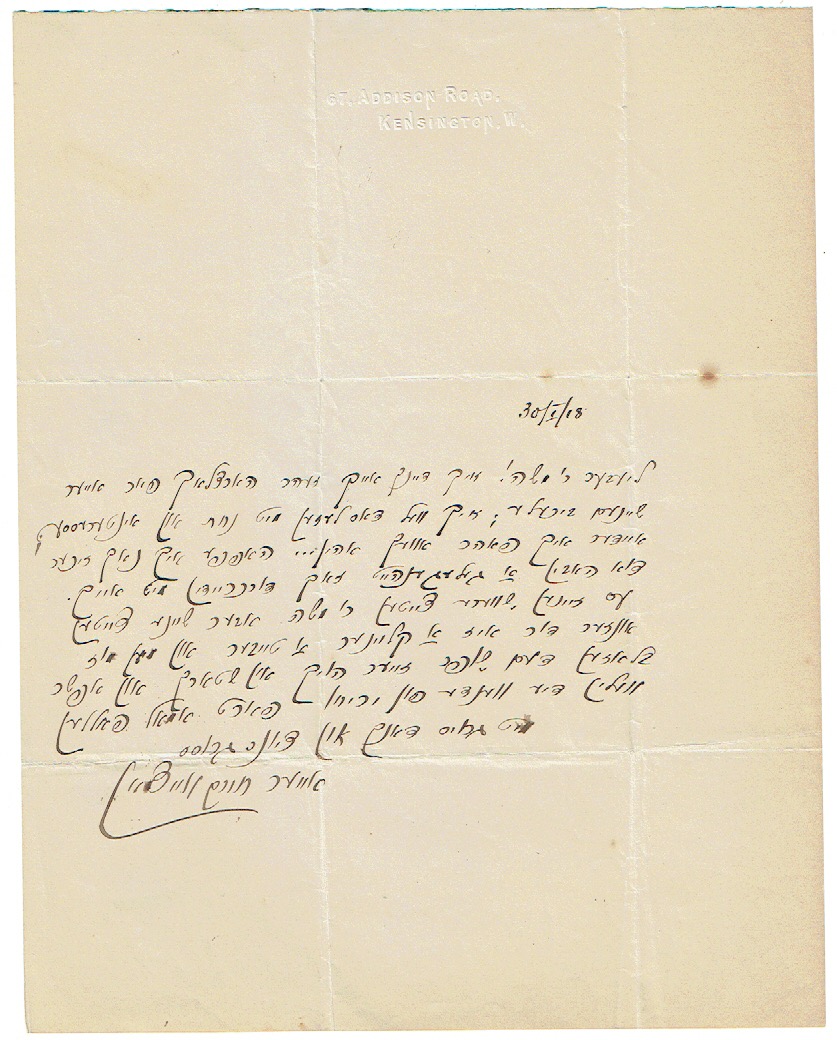
(1874–1952), Jewish scholar and statesman; President of the Zionist World Organization and the Jewish Agency, first President of Israel (1949). Autograph letter signed. London. 4to. 1 page. Blind embossed letterhead.
$ 3,738 / 3.500 €
(73656)
Jewish chemist and statesman (1874–1952) who helped secure the Balfour Declaration of 1917, served as President of the World Zionist Organization, and became the first President of Israel. To Moshe Sharett, in part: “The times are rough my friend, Moshe, but good times are few and valuable. It seems as if blowing a great horn loud and clear is needed, and only then, maybe, the walls of Jericho will collapse.”