Pyotr Ilyich Tchaikovsky

Tchaikovsky, Pyotr Ilyich

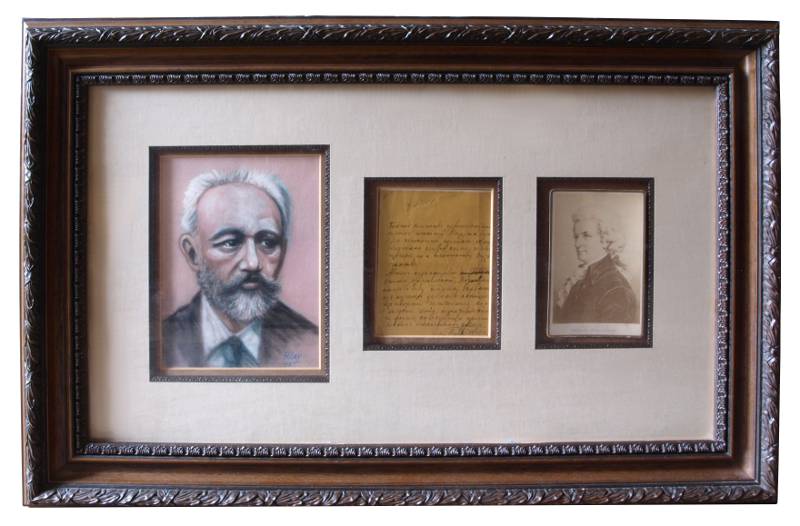
Russian composer (1840-1893). Autograph manuscript signed, in Cyrillic ("P. Tchaikovsky"). No place. 8vo. 1 page. On yellow stationery, light creasing and thumbing, matted with pastel portrait of Tchaikovsky and albumen print photo of Mozart portrait and framed.
$ 20,920 / 18.000 € (72341/BN46143)

Tchaikovsky discusses his newly-composed Orchestral Suite No. 4 Op. 61, usually referred to as "Mozartiana", composed to celebrate the centennial of Mozart's "Don Giovanni". Tchaikovsky personally conducted the debut performance of "Mozartiana" in Moscow in November of 1887. The composition's title is referred to in the heading and in the body of the manuscript.

buy now

Tchaikovsky, Pyotr Ilyich

Russian composer (1840-1893). Autograph letter signed, in Cyrillic ("P. Tchaikovsky"). [St. Petersburg]. 8vo. 2½ pp. on bifolium. With autograph envelope.
$ 32,542 / 28.000 € (77637/BN50219)

Unpublished letter in Russian to Aleksandr Glazunov (1865-1936) in which Tchaikovsky expresses his fatigue and anxieties three weeks before the premiere of "The Queen of Spades" and asks a favour: "I am deadly tired from the opera's rehearsals; tomorrow awaits another one, demanding again great attention and all kinds of anxieties of an author. I am afraid for my disease not to repeat, not going to the concert today. Laziness is unfortunate, but it is necessary [...]. I have a request for you: ask to visit me on Tuesday evening Lyadov [Anatoly Lyadov], both Blumenfelds [Felix and his brother Stanislav Blumenfeld] and Lavrov [Nikolay Stepanovich Lavrov], whom you will not see today, but perhaps you’ll write him a note.

I do not know his address. Remind as well Nikolay Andreevich [Rimsky-Korsakov], I am most convincingly asking him to be at my place on Tuesday evening. And please, do not forget! [...]" (transl.). - This important letter adds to only twelve known letters from Tchaikovsky to his friend and protegé Glazunov, dating from 1887 to 1892. It provides insights into Tchaikovsky's St. Petersburg circle, members of which included the composers Glazunov, Nikolay Rimsky-Korsakov and Anatoly Lyadov, who were part of the so called Belyayev circle, the composer and conductor Felix Blumenfeld (1863-1931), his brother the piano teacher Stanislav Blumenfeld (1850-97), and the pianist Nikolay Stepanovich Lavrov (1861-1927). The letter was written during the rehearsals for "The Queen of Spades" which premiered successfully at Mariinsky Theatre in St. Petersburg on 19 Dec. 1890 (Gregorian calendar). - Folded and slightly smudged; envelope somewhat foxed..

buy now

Tchaikovsky, Pyotr Ilyich

Russian composer (1840-1893). Autograph musical manuscript. "Allegro molto", Dance of the Buffoons (from The Maid of Orleans - Orleanskaja deva). Florence. Oblong folio (353 x 270 mm). Full score for orchestra. Manuscript in black ink on 20-stave paper by "D.T. Éditeur, Paris", mainly on one system per page. 12 pp. on 3 bifolia (only ff. 2-3 still conjoined), lacking one bifolium after f. 5 (portions of f. 1.
$ 290,550 / 250.000 € (82517/BN53642)

Extremely rare musical manuscript: the orchestral score for a dance from "The Maid of Orleans". Composed in 1878-79, with a libretto by the composer, Tchaikovsky's opera in 4 acts premiered on 25 February 1881 at the Mariinsky Theatre in St Petersburg; in the following year it became the first of Tchaikovsky's operas to be performed outside Russia, with a production in Prague opening on 28 July. - The part in this manuscript belongs to Act II, nearing the central moment of the opera when Joan of Arc's victory is announced: at the Château de Chinon, King Charles VII, absorbed in his worries, seeks to distract himself by listening to the minstrels, and three dances follow one another: "Dance of the Gypsies" (Allegro vivace), "Dance of the Pages and Dwarfs" (Allegro moderato), and finally the present "Dance of the Buffoons" (Allegro molto).

- Though lacking a bifolium (bars 173-233), the manuscript is otherwise complete in orchestration and includes a number of revisions by the composer. An elegant copy, the manuscript nevertheless shows some haste in writing, with corrections to the text, a whole bar crossed through, and other corrections (with a slightly thicker pen nib) probably made on checking through. The text offers a number of minor variants from the received printed score, chiefly relating to dynamics and slurrings. - The manuscript's dating poses a puzzle: Tchaikovsky was working on the libretto from about 21 November to 3 December, though in a letter to Mme. von Meck he indicated he did not intend to begin composition until after he had finished work on the orchestral Suite no. 1, whose last two movements he completed on 27 November (the same day as the present manuscript). In the event he did not begin work on the composition until 4 December, according to a letter to his brother Anatoli of the following day; at the end of the opera's autograph he writes that it was begun in Florence on 23 December. The present manuscript therefore precedes the accepted dates for the beginning of composition: its finished condition, and the fact that the "Dance of the Buffoons" would not represent the most obvious starting point for the opera, may mean that it originally formed part of a separate composition, and the coincidence of dates hints at some association with the Suite no. 1 itself. Tchaikovsky had left home late in 1878 for a trip to Florence and Paris, arriving in Florence on 20 November. - Musical manuscripts by Tchaikovsky are extremely rare on the market: prior to the appearance of this manuscript at Christie's more than a decade ago, only a single leaf had been offered for sale in the preceding 30 years, and no substantial manuscript had appeared since before the war. Since then, a 16-leaf working manuscript comprising score drafts of several movements of the orchestral Suite no. 2 was sold at Sotheby's in 2015, commanding £270,000..

buy now