
André Dunoyer de Segonzac
French painter and graphic artist, 1884-1974
André Dunoyer de Segonzac was one of the modernists included in the Armory Show that opened in New York in 1913, with subsequent showings in Chicago and Boston. Segonzac found etching to be a congenial medium to his spontaneous drawing style, and by the end of his life he had produced some 1600 plates. The gossamer quality of his etchings stood in contrast to the thickly painted surfaces and generally somber color of his oil paintings, which reflected his admiration for Courbet and Cézanne. His subjects include landscapes, still lifes, and nudes.
Source: Wikipedia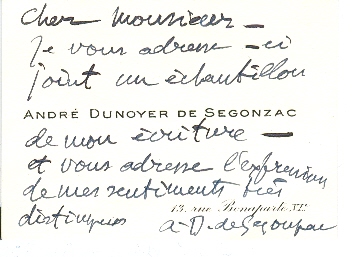
Maler (1884-1974). Eigenh. Visitenkarte mit U. St. Raphael. Mit eh. Briefumschlag.
$ 85 / 80 €
(5312)
André Dunoyer de Segonzac (1884-1974), Maler. E. Visitenkarte m. U., St. Raphael, 15. Mai 1963. Mit e. Briefumschlag. An Herrn Schweighofer, dem er gerne seine Handschrift zur graphologischen Studie schickt.
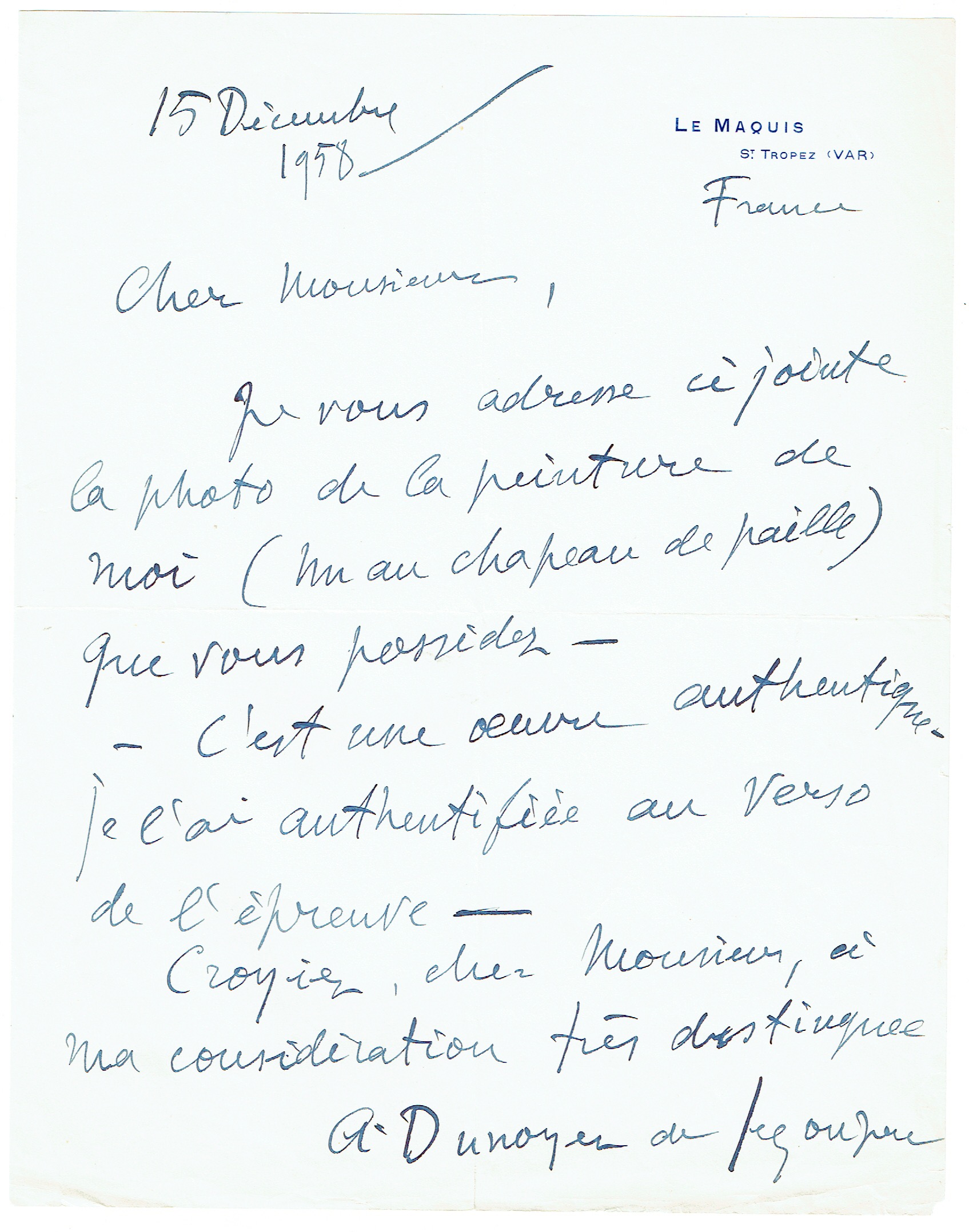
französischer Maler, Grafiker und Illustrator (1884-1974). Eigenhändiger Brief mit Unterschrift. St. Tropez. 4to. 1 p. Gedr. Briefkopf.
$ 691 / 650 €
(83989)
An einen namentlich nicht genannten Empfänger: „[…] Je vous adresse cè jointe la photo de la peinture de moi (un au chapeau de paille) que vous possidez - C’est une oevre authentique - je l’ai authentificé au verso de l’épreuve. […]“ - Beiliegend: erwähnte Photographie mit Bestätigung der Echtheit auf der Rückseite des Malers. Er gehört zu den bedeutenden Vertretern der realistischen Malerei zwischen den Kriegen und der abstrakten Druckgrafik, insbesondere nach dem Zweiten Weltkrieg.


French painter and illustrator (1884-1974). 5 autograph picture postcards signed and 2 autograph letters signed. Paris, Saint Tropez, Signac, Toulon, and n. p. Various formats. Altogether 7 pp. With 2 autograph envelopes. 2 postcards mounted together on cardboard.
$ 851 / 800 €
(90486/BN60234)
Interesting collection comprising letters to the librarian Julien Cain, the painter and art critic Roland Chavenon, the historian René Héron de Villefosse, and the illustrator and designer Georges Lepape.The earliest letter in the collection with a postmark from 20 March 1920 is addressed to Chavenon, thanking him for his "beautiful book", probably "La part de la nature dans l'art" (Paris 1920) and lauding particularly the "chapter dedicated to the decorative arts". A second letter to Chavenon with a Parisian postmark from 15 October 1933 accompanied a text for a periodical named "L'Éclaireur", which might be "a bit long".
- In a postcard from 23 June 1957, Dunoyer de Segonzac congratulates Georges Lepape (not named) on his exhibition "Paris 09-29" that commemorated the glamorous Parisian life of the years 1909-1929 through its decorative arts. Dunoyer de Segonzac expresses his hope that the youth will learn about the 'spring of the century'. - The longest letter in the collection, dated 23 August 1963, was certainly addressed to René Héron de Villefosse. Dunoyer de Segonzac congratulates the historian on the text of his forthcoming book "L'Ile de France" (Paris, 1966) and lays out his ideas for illustrations, while criticising existing designs: "L'illustration graphique d'un tel ouvrage soit être parallèle comme esprit à votre papier : beaucoup de dessins et même de croquis à l'encre de Chine, accompagneraient, je crois, très bien, vos écrits - les dessins synthétiques qui illustrent votre 'Île de France' - sont loin d'être indifférents mais ont, à mon avis, un caractère trop statique et un peu froid". The letter was convincing; the artist ultimately contributed 14 lithographs and 4 woodcuts to the publication. - On 3 February 1968, Dunoyer de Segonzac wrote a postcard to Julien Cain and his wife to thank them for a photograph of Cain and him: "Merci mille fois pour l'excellent et vivante photo en couleur évocatrice de Julien et de moi-même. C'est un témoignage précieux de notre vieille et grande amitié". - The final two postcards in the collection from January 1970 and 1971 are both to thank an unnamed recipient for new year's wishes. - The second letter to Chavenon and the letter to Cain stapled to the original envelopes. The letter to Héron de Villefosse with staple holes. Well preserved..