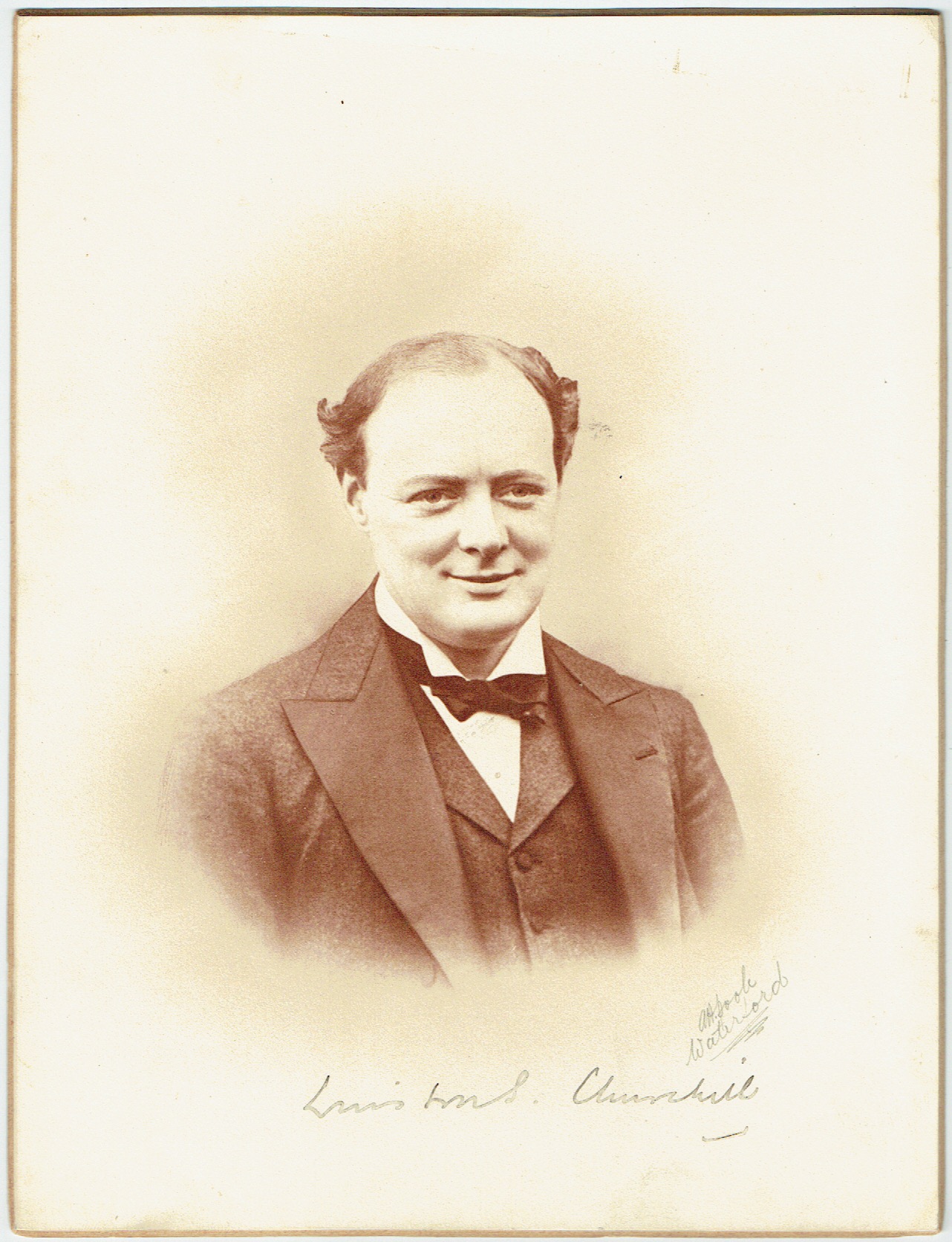
Staatsmann und Literaturnobelpreisträger (1874-1965). Photograph Signed, ‘Winston S. Churchill’. ohne Ort und Datum. 205 : 160 mm.
$ 10,184 / 9.500 €
(91795)
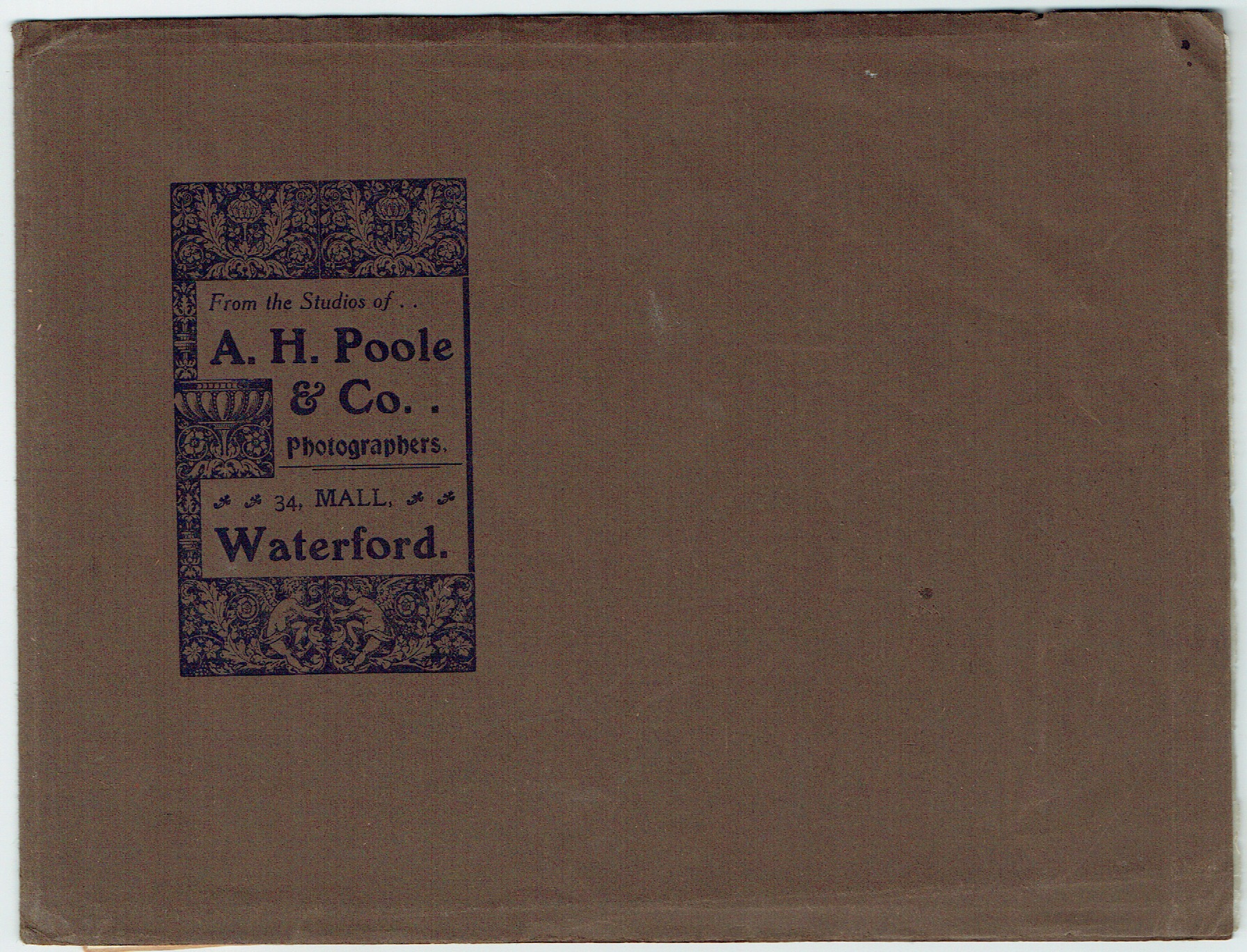
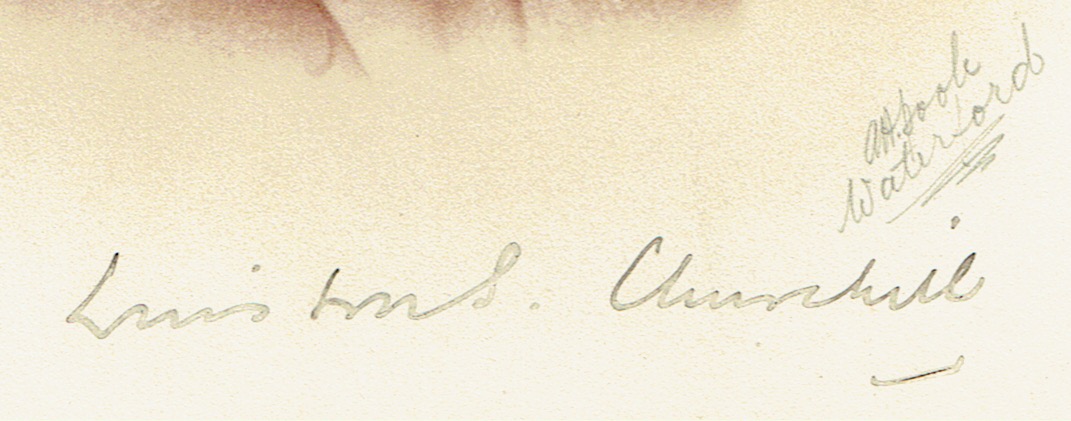
Early circa 1915 matte-finish 6.25 x 8.25 portrait of Churchill smiling in a fine head-and-shoulders pose by A. H. Poole of Waterford, signed across the bottom in ink, "Winston S. Churchill." Also bears the pencil signature of the Poole studio. Flush-mounted on bevelled board with studio’s printed note to verso (‘… this photograph is delicately finished by hand…’), and loosely enclosed in Poole’s original printed wrappers. In fine condition. Accompanied by a brief provenance note, indicating that this photograph was signed for Edith Nancy Bennett who drove Churchill, (and Sir Arthur Duckham), during the First World War.
A very rare, early portrait of Churchill; we have been unable to locate another example, either signed or unsigned. The National Library of Ireland holds Poole's archive, including the negative of this photograph which they, or Poole's archive, date to February 1915..
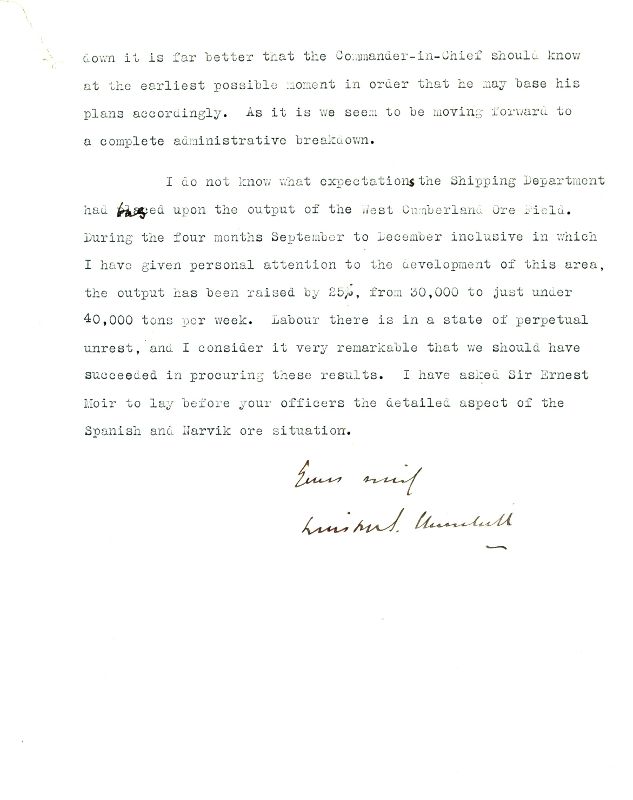
Staatsmann (1874-1965). Typed letter signed. Whitehall. 25.01.1918. 1½ SS. auf Doppelblatt. 4to.
$ 6,968 / 6.500 €
(33289/BN28304)
As Minister of Munitions, a stern wartime letter to his recalcitrant colleague Joseph Paton Maclay, 1st Baron Maclay (1857-1951), on gaining essential military raw material from Spain and Narvik (Norway): "Your letter of the 22nd inst. does nothing to relieve my anxiety. Whether importations of Ore from Northern Spain or from Narvick are considered, it is perfectly clear that shipments are now proceeding at a rate which must lead to a complete breakdown in the Iron and Steel production and so affect every industry concerned in the prosecution of the war.
The Nitrate position is even more serious than the iron and steel, because in this case the whole supply is seaborne, and the entire process of ammunition filling will come to an abrupt arrest. It is, further, very difficult for me to proceed without any idea of what the future has in store. I failed entirely to obtain any answer on this point from your Department. I have to make an enormous series of arrangements for the supply of the Army which depend absolutely upon Raw Material, and we cannot be told even generally within what limits we may expect to be supplied. I have been pressing for information on this vital point for more than three months without receiving anything in return except your invariable courtesy. I really do not know what to do [...] As it is we weem to be moving forward to a complete administrative breakdown [...]". - On stationery with printed letterhead of the Ministry of Munitions; punched holes at top left corner..
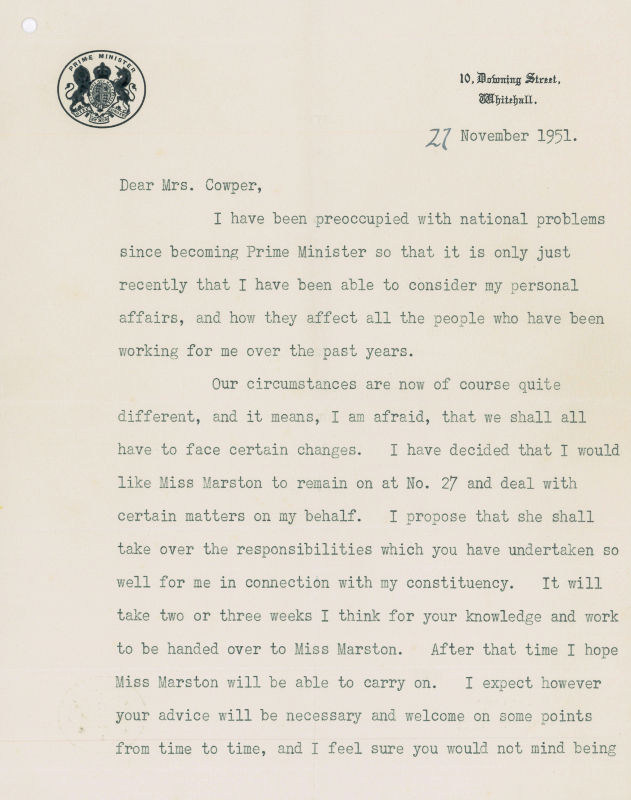
British statesman (1874-1965). Typed letter signed. 10 Downing Street. 27.11.1951. 4to. 1½ pp. on 2 ff.
$ 8,040 / 7.500 €
(34046/BN29760)
To Mrs Cowper, written on his re-accession to power in 1951: "I have been preoccupied with national problems since becoming Prime Minister so that it is only just recently that I have been able to consider my personal affairs, and how they affect all the people who have been working for me over the past years [...] I know how efficiently and happily you have looked after my affairs and interests in my constituency over the past years, and I wish you to know how much Mrs Churchill and I have valued your services and your loyalty [...]. - On engraved headed paper bearing the seal of the Prime Minister and blind-stamp of George VI, filing-hole at head.
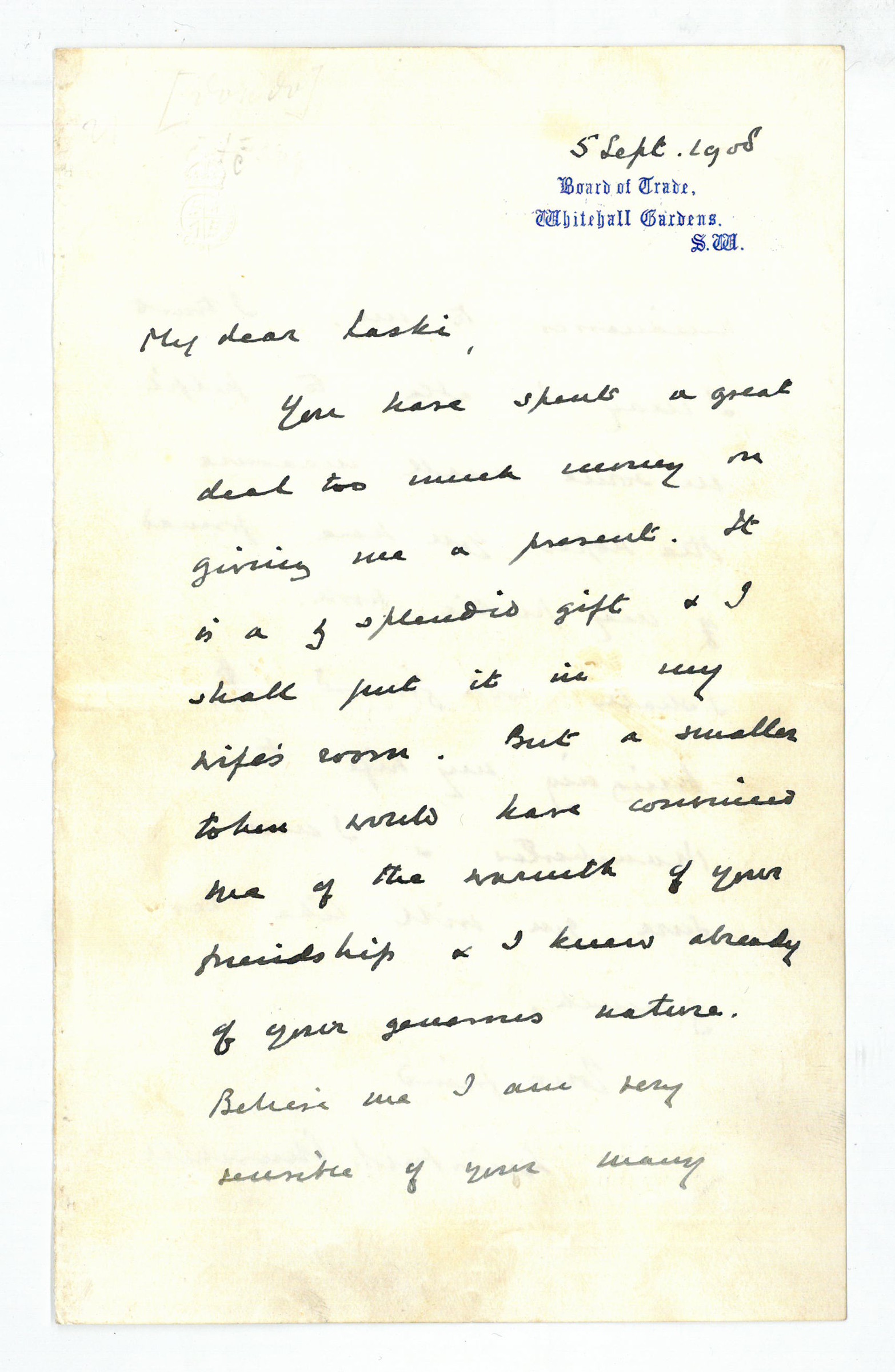


Staatsmann (1874-1965). Eigenh. Brief mit U. London. 2 SS. 8vo.
$ 8,040 / 7.500 €
(91288/BN60296)
An seinen Freund und Gönner, den Unternehmer und liberalen Politiker Nathan Laski (1863-1941), dem er für ein großzügiges Geschenk dankt: "I trust I may be able to fulfill in some small measure the hopes you have formed of my public work. I shall look forward to bringing my wife to Manchester and I am sure you will like her very much. Your friend, Winston S. Churchill". - Laski hatte den jungen Churchill u. a. bei seiner Unterhaus-Kandidatur in Manchester unterstützt; er war der Vater des späteren Labour-Politikers Harold Laski. - Mit blindgeprägtem Wappen des Hosenbandordens am Kopf und auf Briefpapier des "Board of Trade".
sold
Ms. Brief m. e. U.
Autograph ist nicht mehr verfügbar
Winston Churchill (1874–1965). Typed Letter Signed on 10 Downing Street letterhead, underground war rooms in London, December 21, 1940 (the very day German bombers left Victoria Station in flames), to an American named Mrs. Sears. “Thank you very much for your kind letter. It is encouraging to feel that we have the ever-increasing sympathy and support of the people of the United States, and especially of New England, in this great struggle.” – This letter is historically important for two reasons. One lies in the knowledge that Churchill felt that Britain’s support in the U.S. was increasing, a prime goal of his and something crucial to Britain’s survival. Time would bear out the accuracy of this conclusion. The second lies in the view it provides into Churchill’s soul at this key moment in world history (and the high-water mark of the leadership which won him everlasting renown), evidenced by his classification of the war against Hitler, even at that early date, as “this great struggle.” Although Churchill left a voluminous correspondence, letters written during the Blitz in 1940 are so uncommon that a search of auction records discloses just one other comparable one having been offered over the last 30 years.
Typed letter signed ("Winston").
Autograph ist nicht mehr verfügbar
To his aunt Leonie Leslie on his first flat and a trip to Paris. Churchill rejoices in being established in his first bachelor quarters, a set of "beautiful rooms" in Mount Street which have been passed on to him by his cousin Sunny (9th Duke of Marlborough); he is now much more comfortable than when living with his mother at Cumberland Place, "but of course I no longer live for nothing". He asks his aunt to help him improve the rooms on her return from Ireland, being himself indifferent to this sort of "material arrangement [...] so long as my table is clear and there is plenty of paper, I do not worry about the rest". He has just returned from Paris with Sunny and his other cousin, Ivor [Guest], and reports unfavourably on the Exposition Universelle, criticising the lack of "cleverness" in the arrangements, comparing large parts of the exhibition to "parts of Whiteley's shop", and in particular finding fault with the inefficiency of the characteristically French trio of ticket seller, ticket puncher and ticket collector at the door of each stall. - Until moving into Mount Street, Churchill had continued to use his mother's house at 35a Cumberland Place as his London home; he was to remain in Mount Street until 1905. The 1900 Paris Exposition Universelle inaugurated a number of Paris's most celebrated buildings, including the Grand and Petit Palais, the Pont Alexandre III and the Gare (now Musée) d'Orsay, as well as the first line of the Paris Metro. - On headed paper; previously laid down (fol. 1 missing lower right corner)
Vertrag mit eigenh. U.
Autograph ist nicht mehr verfügbar
Memorandum of agreement between Churchill and his publisher for the rights to publish Churchill's "Europe Since the Russian Revolution". One of the few literary projects that Churchill ever abandoned, his projected work on Europe since the Russian Revolution would surely have been a fascinating addition to the Churchillian canon. This contract with Harrap called for the author to receive the generous amount of £13,500, payable in installments: £1,500 up front; £2,000 on the delivery of the first part of the manuscript; £3,000 on the delivery of the second; and £7,000 on delivery of the third. These payments would be in lieu of any royalties. The contract calls for the first portion of the manuscript to be delivered by no later than June 1941, with Churchill obligated to return his advance with interest for failure to do so. Since this is precisely what happened, this paragraph is boldly marked thrice in pencil in the margin. - Churchill's demanding obligations as member of the War Cabinet and then as Prime Minister and saviour of Britain in 1940 did not leave Harrap in a forbearing or forgiving mood when Churchill tried to get out of this contract. Indeed, his growing stature made him all the more valuable as a literary commodity. As called for in paragraph 10 of this document, the matter went to arbitration, with Churchill arguing that he had completely lost interest in the subject of Europe since the Russian Revolution. In any case, he was in no position to do anything about it: "I suppose I have not read a dozen books in the last five years." Besides, he added, writing about Russian relations might injure the delicate wartime alliance with Stalin. More than anything else, however, Harrap's hardball tactics annoyed him. When the publisher offered new contracts with much more generous terms, Churchill curtly refused, saying "I do not want to have any further dealings of any kind with them." Realizing he was beat, Harrap unconditionally surrendered on 7 September 1944, saying "it is distasteful to us, whether we are right or not, to litigate this matter with a man to whom every one of us is so much indebted" (cf. Reynolds, In Command of History, pp. 19-20). Churchill gave back the £1,500 advance with interest and went on to publish his war memoirs with Macmillan and Cassell's. - Somewhat dusty and frayed.
Ms. Mitteilung mit eigenh. U.
Autograph ist nicht mehr verfügbar
Brief m. e. Anrede u. U.
Autograph ist nicht mehr verfügbar
Winston Churchill (1874–1965), Staatsmann. Ms. Brief mit e. Anrede, Grußzeile und U., Chartwell (Kent), 28. Februar 1939, 1 Seite 8°. – An den britischen Filmproduzenten Reginald Fogwell von der British Empire Film Productions: „I thank you for your letter of February 25, but regret that I am much too occupied at the present time to entertain the proposition you have kindly made to me [...]“. – Auf Briefpapier mit gepr. Briefkopf.
Ms. Brief mit eigenh. Anrede, Grußformel und U.
Autograph ist nicht mehr verfügbar