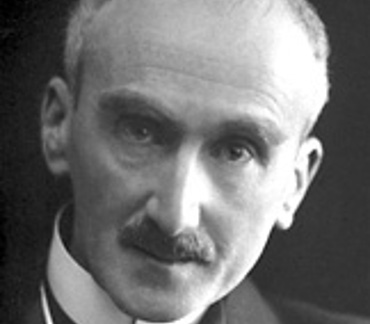
Henri Bergson
Philosoph, 1859-1941
Henri Bergson gilt neben Friedrich Nietzsche und Wilhelm Dilthey als bedeutendster Vertreter der Lebensphilosophie. Bergsons markantestes Philosophem ist der Begriff des „élan vital“, den er in seiner Philosophie des Lebendigen („Die schöpferische Entwicklung“) in genauer Kenntnis der Lebenswissenschaften seiner Zeit entfaltet. Ein weiteres Hauptwerk ist das 1896 erschienene Buch „Materie und Gedächtnis“, in dem Bergson eine neue, weder idealistische noch empiristische Theorie der Wahrnehmung und der Beziehung von Körper und Geist entfaltet. 1927 erhielt er den Nobelpreis für Literatur.
来源: Wikipedia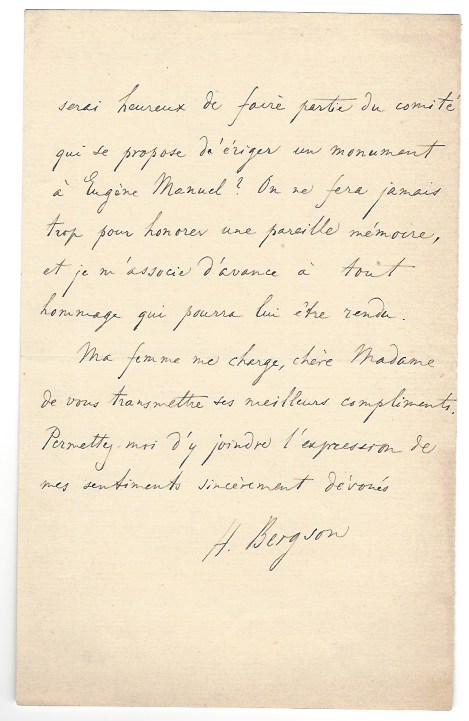
Philosoph und Nobelpreisträger für Literatur 1927 (1859-1941). Eigenh. Brief m. U. Paris. 8vo. 2 pp.
$ 1,018 / 950 €
(60546)
Bergson teilt mit, dass es kein Fehler sei, dass sich sein Name auf der Liste befinde, er aber seit mehreren Jahren schon nicht mehr „de baccalauréats“ sei.

Schriftsteller (1859-1941). 5 autogr. letters signed. 8vo. 13pp.
$ 4,821 / 4.500 €
(60552)
1) 18 May 1911: Departs for Oxford, where he is to lecture. 2) 20 Sept. 1918, having returned from New York, to Alfred Rebelliau: an American magazine is waiting for an article on the religious movement in France. 3) 24 Sept. 1918, to Eugene-Louis Bouvier, thanking him for his book on "the psychic life of the entire insect [...] thoroughly, and in its purely mechanical reactions, and in its instinctive activity, and in its intelligent manifestations. [...] the role of science is to push as far as possible the 'rationalization' of instinct […]".
4) 17 March 1921, to the same, thanking him for his "beautiful book on the habits and metamorphoses of insects [...] I have a hard time representing to myself the intelligence at the origin of instinct". 5) 14 Nov. 1927, to President Raymond Poincaré, thanking him for sending "L'Union Sacrée", which shows that the Germans have "done everything to bring the war", that we have "done everything to avoid it", and that "makes us relive with singular intensity the tragic hours which preceded and immediately followed the declaration of war". - Includes a business card with 6 autograph lines..

French philosopher and Nobel Laureate (1859-1941). Autograph letter signed ("HBergson"). Paris. 08.01.1915. Small 4to. 1½ pp. on bifolium.
$ 857 / 800 €
(33883/BN29533)
To M. Derougemont.
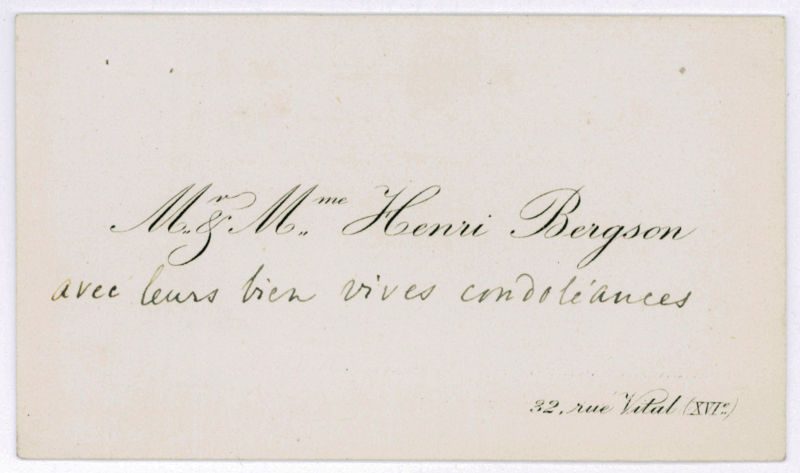
French philosopher and Nobel Laureate (1859-1941). Calling card with 1 autograph line. N. p. o. d. 1 p.
$ 161 / 150 €
(33884/BN29534)
"M. & M. Henri Bergson | avec leurs bien vives condoléances".

philosopher (1859-1941). Visiting card with autograph dedication. Envelope added. St. Cergue [Switzerland]. Visiting card format. Envelope (144 x 84 mm).
$ 268 / 250 €
(940709/BN940709)
To Paul Flat (1864-1918), French essayist and editor, being touched by the congratulations and sending his best regards: "[...] très touché des fèlicitaions de son cher et éminent confrère M. Paul Flat, le prié d'accepter ses meilleurs remerciements [...]". - 1900 Bergson became Professor at the Collège de France. - On lithographed preprinted visiting card, noting "Henri Bergson Membre de l'Institut, Professeur au Collège de France, Villa Montmoreney / 18. Avenue des Tilleuls / Auteuil". Collector's note in blue pencil.
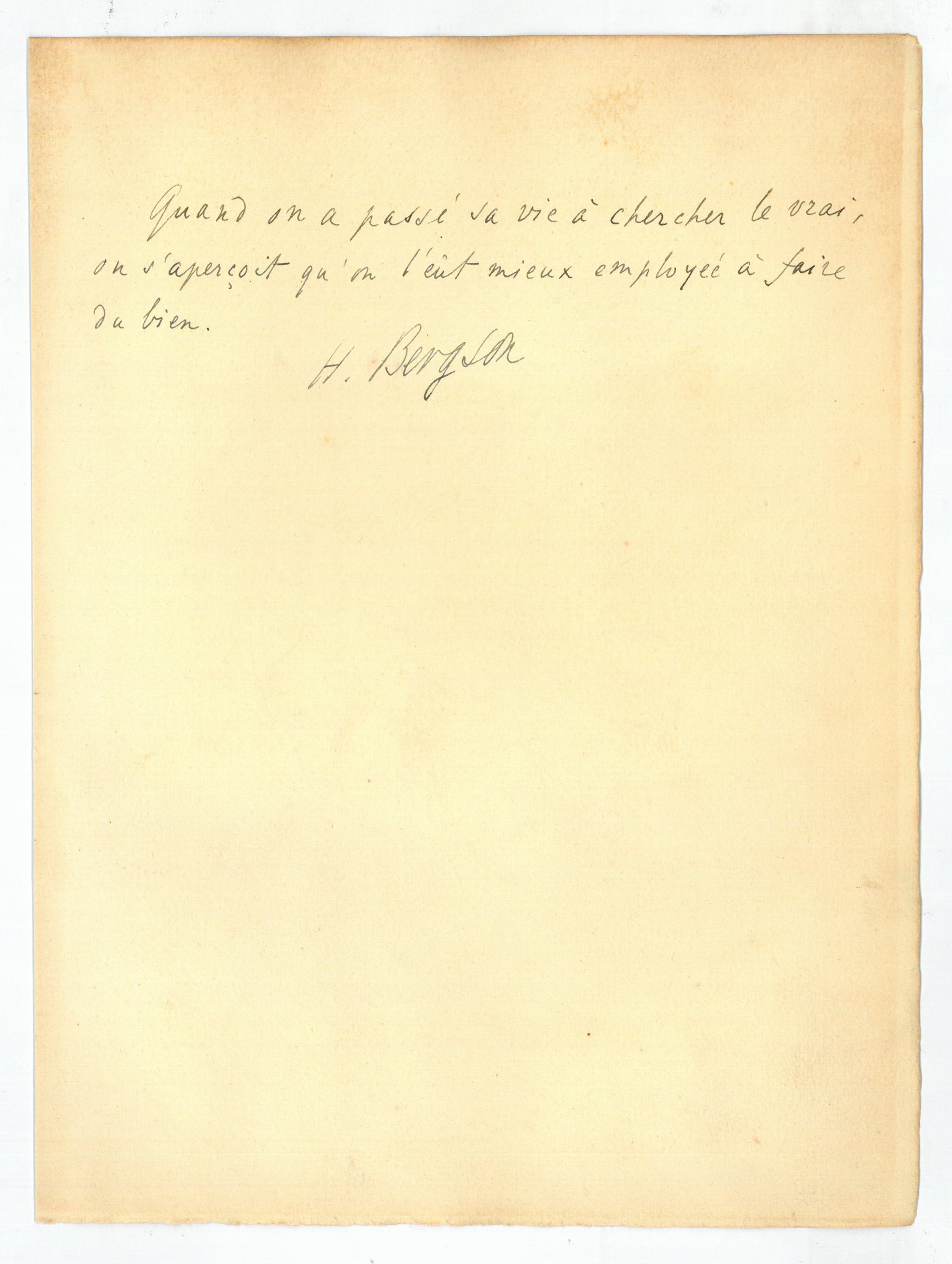
French philosopher (1859-1941). Autograph quotation signed. N. p. 4to. 3 lines.
$ 1,607 / 1.500 €
(85871/BN56546)
Philosophical aphorism valuing good deeds over the contemplative search for truth: "Quand on a passé sa vie à chercher le vrai, on s'aperçoit qu'on l'eût mieux employée à faire du bien". This beautiful quotation was part of the 1959 anniversary exhibition at the French national library. - Insignificantly browned.